
The department has all types of modern teaching- learning resources in the department.
| Name of Lab | Details |
| Networking and IoT Laboratory | The Networking and IoT Laboratory is a modern , dedicated to providing students with hands-on experience in cutting-edge computing technologies. A Networking and IoT Laboratory can support various courses across different levels of study, ranging from foundational networking to advanced IoT and cybersecurity. Below is a list of courses that can be supported by such a laboratory: 1.Networking Basics 2. Advanced Networking 3. IoT Basics 4. IoT Applications 5. Cybersecurity 6. Cross-disciplinary Courses Resources: 1)Desktop 2) Projector 3) UPS Knowledge Creation-
By focusing on these areas, the lab can position itself as a center for innovation, research, and learning, contributing significantly to the academic and technological ecosystem. |
| Image Processing and Computer Vision Laboratory | Image Processing and Computer Vision Laboratory helps: -Understand the fundamental concepts of image processing and computer vision. -Develop hands-on skills in image acquisition, enhancement, transformation, and analysis. -Explore object detection, recognition, and tracking techniques. -Learn to implement and optimize computer vision algorithms. -Use modern tools and frameworks for practical applications in fields like robotics, healthcare, and autonomous systems. Resources: 1) Desktop 2) Smartboard 3)OS 4)MS office 5) Programming language 6)Java Knowledge Creation-
By leveraging these strategies, the lab can become a center for cutting-edge research, impactful applications, and robust educational experiences in image processing and computer vision. |
| Programming Laboratory | The Programming Laboratory aims to provide students with hands-on experience in software development, problem-solving, and understanding computational logic. It equips learners with practical knowledge of programming languages, tools, and methodologies necessary for modern software development. Resources: 1)Free code camp 2) Code academy 3) Coursera 4)Udemy 5) edX 6) other programming languages etc. Knowledge Creation-
By actively engaging in research, collaboration, and real-world applications, programming language labs and developers can push the boundaries of software development and computing. |
| Advanced Software Engineering Lab | The Advanced Software Engineering Laboratory is designed to provide students with hands-on experience in developing, managing, and maintaining complex software systems. It focuses on applying advanced methodologies, tools, and frameworks in software development, testing, and project management to solve real-world problems effectively. Resources: 1)Desktop 2) Projector 3) PA system 4)Router 5) OS 6) MS Office etc. Knowledge Creation-
The Advanced Software Engineering Lab bridges the gap between theoretical learning and practical implementation, preparing students for industry and research roles. |
| Artificial Intelligence and Machine Learning Laboratory | The Artificial Intelligence (AI) and Machine Learning (ML) Laboratory is designed to provide students with practical experience in developing and implementing AI and ML algorithms. The lab offers hands-on learning with real-world applications such as natural language processing (NLP), computer vision, reinforcement learning, and deep learning. Resources: 1)OS 2) Programming Languages 3) AI/ML framework and libraries 4)Cloud Platforms etc. Knowledge Creation-
The AI and ML Laboratory equips students with the knowledge and experience required to develop advanced AI models and applications, preparing them for roles in industries such as healthcare, finance, robotics, and autonomous systems. |
| Innovation and Project Laboratory | The Innovation and Project Laboratory is designed to foster creativity, problem-solving, and hands-on experience in building real-world projects. This lab aims to provide students with the tools, resources, and mentorship required to turn innovative ideas into functional prototypes or fully developed projects. The lab focuses on developing interdisciplinary skills, with a strong emphasis on collaborative project-based learning, research, and product development. Resources: 1) Desktop 2) Smartboard 3)OS 4)MS office 5) Programming language etc. Knowledge Creation-
The Innovation and Project Laboratory offers students an environment where they can take their ideas from concept to prototype, with access to cutting-edge tools, technology, and mentorship. This hands-on experience prepares them for careers in technology development, product design, entrepreneurship, and research. |
| PG Research Laboratory | The PG Research Laboratory is designed to support postgraduate students in conducting advanced research across various fields of technology, engineering, and applied sciences. The lab provides an environment conducive to deep academic exploration, allowing students to engage in both theoretical research and practical experiments. The goal is to foster innovative research, develop new technologies, and contribute to scientific advancements. Resources: 1) Desktop 2) Smartboard 3)OS 4)MS office 5) Programming language etc. Knowledge Creation-
The PG Research Laboratory provides an ideal environment for postgraduate students to deepen their expertise, engage in cutting-edge research, and contribute to advancements in science and technology. It equips students with the tools and experience necessary to pursue successful careers in research, academia, or industry. |
| Sr. No. | Particulars |
| 1 | High-End Forensic Workstation (with Service) (Hardware) |
| 2 | All in One Portable Write Blocker (CRU or WiebeTech) (Hardware) |
| 3 | Portable Hardware Toolbox ltem (Hardware) |
| 4 | Digital Forensic Software – Belkasoft Evidence Center X (Software) |
| 5 | Password Recovery/File Decryption -PasswareXit Forensic (Software) |
| 6 | Vulnerability Scanner Tool (Software) |
| 7 | lnstallation, Commissioning and Training ltem: Service License Type I One Time & Additional online Refresher Training: 3 times |
| Sr.No. | Name of Hardware/ Servers | Name of Components |
| 1 | Deep Learning Server | ELSPL/RI/NVIDIA/ CEE/TEGRER-LI/Flutech Learning |
| 2 | IoT related hardware | 1.Raspberry Pi 4 4gb 2.Arduino Uno R3 Board 3.Pi Expansion Board with XBEE connections 4.Infrared distance meter |
| 3 | AR – VR related hardware | 1.VIVE Pro Virtual Reality System Display: Dual AMOLED 3.5″ diagonal1440 x 1600 pixels per eye2880 x 1600 pixels combined90 Hz refresh rate110-degree field of view . 2.Oculus Quest 2 Virtual Reality Headset Processor: Qualcomm Snapdragon XR2 Internal Storage: 256 GBIPD Distance: 2.3 to 2.7″/58 to 68 mm Audio Input: None Audio Output: 1 x 1/8″/3.5 mm |
| 4 | Drone technology related hardware | 1.DJI Tello Drone Extra Battery (Quad) 2.Flight Controller Pixhawk (Only) 3.Telemetry Kit 4.RC Plane Frame |
| 5 | Robotics related hardware | 1.Snapmaker 3 in 1 CNC machine 2.Jetson Nano – Module and Developers Kit 3.Dobot Magician Robotic Arm 4.Turtle Bot |
| Sr.No. | Names of Software |
| 1 | CodeZinger |
| 2 | GIS and remote sensing package |
| Sr No | Description as per Standard Specifications from tender | Quantity |
| 1 | Education Bundle- GIS and Remote sensing Package ERDAS Imagine Professional (5 user OEM software licenses) | One set with 5 user OEM software licenses |
| ERDAS Professional (includes Easytrace, Vector, Enterprise Loader, Image Equalizer, ER Mapper and Radar Interpreter) | ||
| IMAGINE Expansion Pack (includes Autosinc, VirtualGIS, DeltaCue, ortho Radar, NITF, StereoSAR DEM and Stereo Analyst for IMAGINE) | ||
| GeoMedia Professional (includes Grid, Fusion, Transaction Manager, Public Works Manager AND Parcel Manager) | ||
| The software delivered will be perpetual in nature (Life time) | ||
| One year warranty/support from the date of invoice |
| S.N. | Name of the Laboratory |
| 1. | Mac Lab Center of Excellence Seating capacity: 30 |
| 2. | Dell – Intel sponsored ‘AI for Youth’ lab Seating capacity: |
| 3. | Collaborations and Partnerships: A) IIT Bombay vLabs |
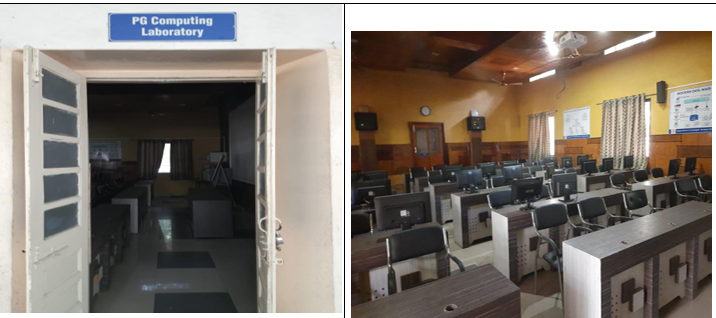
Table: List of certified faculty members in iOS App development
S. NO. | Name of the faculty | Date of certification |
1 | Ms. Aprupa. S. Pawar | 27th June 2023 |
2 | Mrs. Swapnali. A. Aitwade | 27th June 2023 |
3 | Ms. Nandinee. L. Mudegol | 28th July 2024 |
4 | Mr. Siddharaj. D. Pujari | 1st July 2024 |
F. Lab Photos:
Empowering minds since 1947. Building a legacy of excellence in engineering education.
Address:
Walchand College of Engineering, Vishrambag, Sangli – 416415, Maharashtra, India.
Stay up to date with our latest news, upcoming events, and more…